Woman Offers Her Horse Yard as a Free Wedding Venue—Then Her Sister Demands the Horses Be Removed
A generous offer gave one bride access to a beautiful orchard for free. The arrangement fell apart, however, when her requests began threatening the working business—and the animals—behind the picturesque setting.
Picture this: you are planning your wedding, and a family member offers you a beautiful outdoor space without charging a venue fee. It sounds like a dream—until you remember that the space is part of a working livery yard where horses live, customers visit and a family earns its livelihood.
That distinction sits at the heart of a family dispute that attracted widespread attention online. What began as a thoughtful favor reportedly turned into an argument about horses, business responsibilities and the limits of family generosity.
The Story in Brief
- A woman and her husband operated a livery yard where they cared for their own horses and horses belonging to paying customers.
- Her sister asked to hold her wedding reception in the property’s orchard.
- The couple agreed to provide the space without charging a venue fee.
- The bride later requested major changes that would have disrupted the yard’s daily operations.
- The property owner refused to close the business and relocate the horses.
- The disagreement escalated, and the bride reportedly ended contact with her sister.
- Most readers supported the yard owner and considered her boundaries reasonable.
The central lesson: A free venue is a generous gift, not permission to take control of someone else’s property, business or responsibilities.
A Generous Offer
The woman and her husband ran an active livery yard. In addition to keeping their own horses there, they provided accommodation and care for animals belonging to regular customers. Her husband also worked as a riding instructor.
When the woman’s sister asked to use the orchard for her wedding reception, the couple hesitated but ultimately agreed. They believed they could reserve a separate area for the celebration while continuing to operate the rest of the yard.
It was a valuable offer. The bride would receive an attractive outdoor setting without paying the normal cost of hiring a commercial venue, while the owners would absorb the inconvenience of preparing their property for a large family gathering.
The couple reportedly agreed to accommodate a baby shower on the following day as well. At that stage, the arrangement still appeared manageable—as long as the event remained separate from the working areas of the yard.
Then the Demands Grew
According to the account, the bride later presented a much more demanding list of expectations. She did not merely want the orchard cleaned and prepared. She reportedly wanted the entire property transformed for the wedding and the following day’s baby shower.
Her reported requests included:
- Closing the livery yard to customers during both events.
- Keeping employees away from the property.
- Thoroughly cleaning the stable and surrounding areas.
- Removing the couple’s horses from the premises.
- Relocating horses belonging to paying customers.
- Keeping the property clear for the wedding and the next day’s gathering.
The bride was reportedly concerned that the normal appearance and smell of a working stable would spoil the atmosphere she wanted to create.
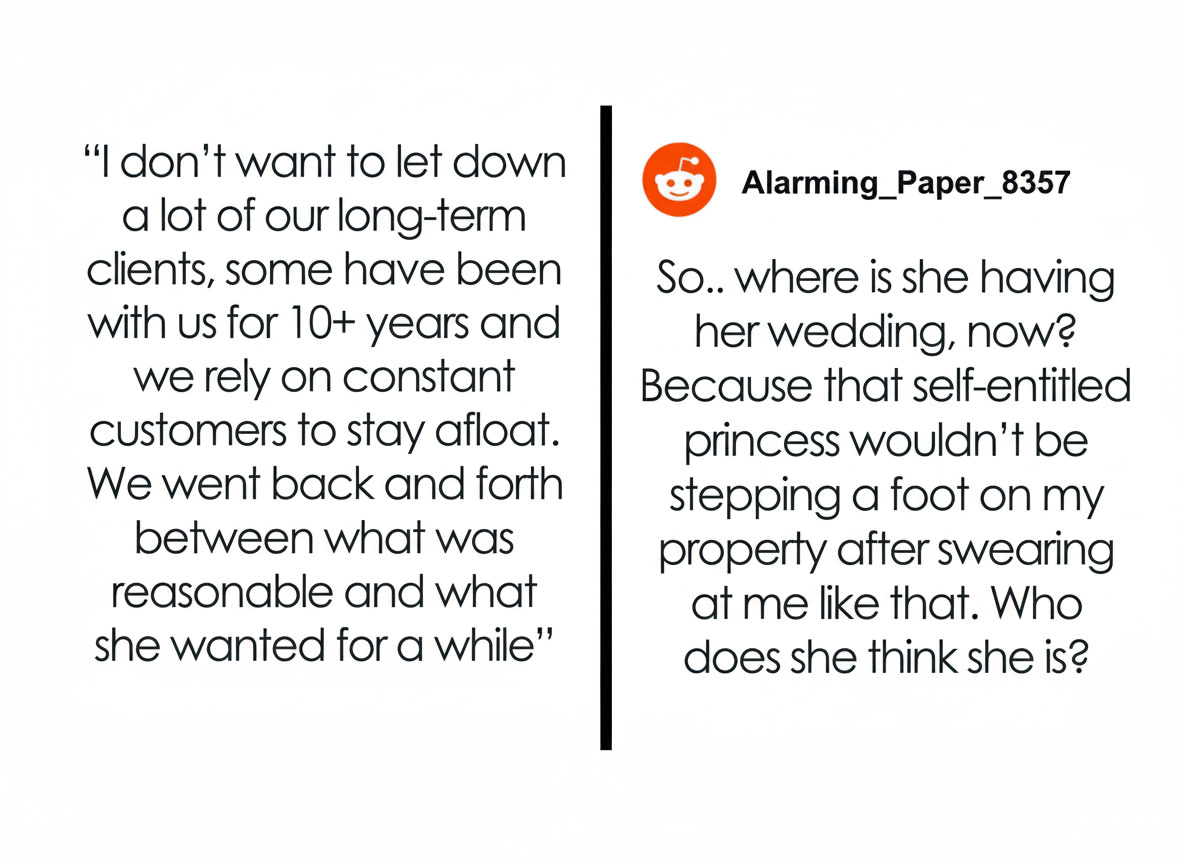
For the owners, however, these were not small requests about decorations or seating. Meeting them would have meant suspending their business, disappointing customers and finding temporary accommodation for multiple horses.
A Yard Is Not Scenery
The conflict appears to have grown from two very different views of the same property. The bride saw a picturesque orchard that could become a wedding venue. Its owners saw an active workplace built around animals, employees and paying clients.
A livery yard cannot simply stop functioning because an event is taking place nearby. Horses still need food, water, exercise, supervision and appropriate care. Employees may need access to the animals, while customers reasonably expect the services for which they are paying.
A wedding may last one day, but trust between a business and its customers can take years to build.
Moving the horses would not have been a simple solution either. Safe relocation requires suitable transportation, experienced handlers, available stabling and permission from the owners of any client horses involved.
The request therefore affected far more people than the two sisters. It potentially involved the couple’s employees, customers, animals and professional reputation.
Why the Owner Said No
The property owner refused to close the yard and remove the horses. She was reportedly still willing to provide the orchard under the original arrangement, but she would not risk the business or disrupt the animals’ care to create a completely horse-free environment.
Her sister allegedly responded by accusing her of being selfish and unsupportive. Their mother also became involved and reportedly sided with the bride, turning a disagreement about venue logistics into a much larger family conflict.
The bride’s fiancé later contacted the property owner and apologized. His response suggested that he did not fully support how the situation had been handled.
Unfortunately, the apology did not repair the relationship between the sisters. According to the account, the bride eventually cut off contact with the woman who had originally offered to host the celebration for free.
Why Readers Supported Her
Most commenters sided with the livery-yard owner. Their reasoning was straightforward: she had already offered something valuable, but her sister appeared to treat that favor as the beginning of a negotiation for even more.
- The venue was free: The owner was not selling an exclusive wedding package with full control of the property.
- The yard was still a business: Employees and customers had existing responsibilities and arrangements.
- The horses required continuous care: Their needs could not be paused for a celebration.
- The original offer had limits: The orchard was available, but the entire property was not.
- Another venue remained an option: If a stable-free environment was essential, a conventional wedding venue would have been more appropriate.
A Favor Is Not a Blank Check
The deeper issue was not whether the bride could make requests. Couples naturally need to ask questions about access, cleaning, parking, decorations and privacy when planning a wedding.
The problem arises when a request threatens the host’s livelihood or ignores the conditions attached to the offer. At that point, it stops feeling like a request and starts becoming a demand.
When someone offers a garden, orchard, barn or home for free, the property does not temporarily become the couple’s possession. The host still has the right to establish boundaries, protect the property and continue meeting existing responsibilities.
Generosity does not transfer ownership. Accepting a favor also means respecting the limits attached to it.
A Free Venue Still Has Costs
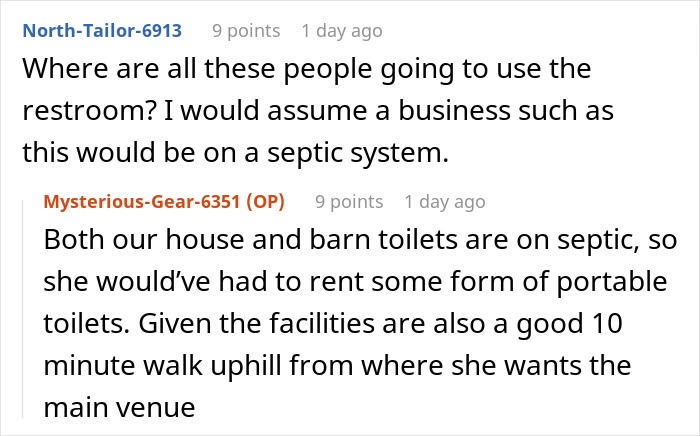
No money may change hands, but that does not make a private venue cost-free. The host may still provide time, labor, cleaning, utilities, parking, preparation and access to valuable property.
Hosting an event can also create less obvious costs, including disruption to normal routines, damage to the grounds and potential lost income. A considerate guest recognizes those burdens instead of assuming the host will quietly absorb them.
A gracious couple can offer to pay for professional cleaning, additional insurance, temporary facilities or repairs. Even if the host declines payment, making the offer demonstrates appreciation and responsibility.
Why a Livery Yard Is Different
A working stable can be a beautiful setting, but it is not the same as a purpose-built wedding venue. Any event near horses requires realistic planning and clear boundaries.
- Animal welfare: Sudden noise, crowds and unfamiliar activity may disturb some horses, so their individual needs and normal care routines must come first.
- Guest safety: Children, alcohol, vehicles and large animals can be a dangerous combination without restricted areas and appropriate supervision.
- Customer access: Livery clients may have contractual or practical expectations concerning access to their horses.
- Insurance: Ordinary property or business coverage may not automatically cover every risk associated with a private event.
- Local requirements: Rules concerning gatherings, food, structures, parking and alcohol vary by location and should be checked in advance.
- Property damage: Marquees, vehicles, tables and heavy foot traffic can damage grass, tracks, fences and orchard areas.
- Biosecurity: Additional visitors, vehicles and equipment may require sensible controls around animal areas.
British Horse Society guidance for equestrian events recommends separating horse routes from public or vehicle routes where reasonably possible. It also emphasizes supervision of children and avoiding excessive noise around horses. View the guidance.
Insurance requirements depend on the event, property and jurisdiction. Event liability coverage can help address certain injury or property-damage claims, and some venues may require proof of coverage. Hosts and couples should speak directly with their insurer rather than assume an existing policy is sufficient. Read general event-insurance guidance.
Reasonable or Over the Line?
| A Reasonable Request | Going Too Far |
|---|---|
| Asking whether the space is available and which dates work. | Expecting the business to close or turn away paying customers. |
| Discussing which areas guests may use. | Assuming every part of the property is included. |
| Offering to cover cleaning, insurance or additional facilities. | Expecting the host to absorb every cost. |
| Following the owner’s animal-safety rules. | Overriding those rules for photographs, decorations or convenience. |
| Accepting normal features of a working yard. | Demanding that the horses and staff disappear. |
| Expressing sincere appreciation. | Treating the favor as something the couple is owed. |
If You Are the Host
Offering private property for a wedding can be a wonderful gift, but informal arrangements can easily produce conflicting expectations. Clear terms protect both the relationship and the property.
- Decide your limits first. Set the date, hours, guest limit, parking arrangements and restricted areas before agreeing.
- Put the arrangement in writing. Record who will handle cleaning, setup, damage, utilities and waste removal.
- Check your insurance. Tell your insurer exactly what kind of event is planned, including the expected number of guests and whether alcohol will be served.
- Confirm local requirements. Depending on the location and scale, permission may be needed for structures, amplified music, food service or alcohol.
- Protect the animals. Establish barriers, quiet zones and routes that keep guests away from working areas.
- Choose one contact person. Communicate with the couple or one designated planner instead of negotiating with multiple relatives.
- Reserve the right to withdraw. If the event grows beyond the original agreement, you should be able to reconsider the offer.
If You Are the Couple
- Ask questions instead of making assumptions.
- Accept the host’s answer, even when it is not the answer you wanted.
- Offer to pay for cleaning, insurance, portable facilities or additional labor.
- Keep requests proportionate to the favor being offered.
- Follow all rules concerning animals, employees and restricted areas.
- Prepare a backup venue in case the arrangement becomes impractical.
- Thank the host privately and publicly.
- Leave the property in the same or better condition than you found it.
What Could Have Prevented the Dispute?
The disagreement might have been avoided if both sisters had defined the arrangement before making wedding plans around it.
- An early site visit: The bride could have experienced the normal appearance, sounds and smells of the yard before accepting it.
- A written list of included areas: The orchard could have been clearly separated from the stable, riding and customer-access areas.
- A discussion about operating hours: Everyone could have understood that the business would remain open.
- A realistic event plan: Parking, music, guest movement and cleanup could have been addressed before invitations were sent.
- A backup option: The couple could have selected another venue if complete privacy was non-negotiable.
- Respectful communication: Both sides could have discussed alternatives without turning practical limits into accusations about family loyalty.
Frequently Asked Questions
Is it wrong to refuse a family member’s request to use your property?
No. Protecting your home, animals, customers or business is a reasonable boundary. A clear refusal is usually healthier than a reluctant agreement that later creates resentment.
Should a relative be charged for using a private venue?
That decision belongs to the property owner. A fee or refundable damage deposit can help cover costs and clarify expectations. Even when the venue is free, responsibilities and limits should still be written down.
Can horses and wedding guests safely share a property?
Potentially, but only with careful planning. Guest areas should be separated from horse routes and stable operations, children should be supervised, noise should be controlled and access to the animals should be restricted.
Is event insurance always required?
Requirements vary according to the country, local rules, property, guest count, vendors and whether alcohol will be served. The property owner and couple should confirm coverage directly with their insurers and relevant local authorities.
What if the couple changes the plan after the host agrees?
The host can review the new proposal and decline changes that exceed the original agreement. Agreeing to one version of an event does not require accepting every later addition.
The Bigger Lesson
This story is not only about a wedding or a group of horses. It is about what happens when gratitude is replaced by entitlement.
A family favor should make someone’s life easier without placing an unreasonable burden on the person providing it. Once the favor threatens a livelihood, disrupts existing commitments or compromises animal care, the request needs to change—not the giver’s boundaries.
Weddings are important, but no celebration gives someone the right to take control of another person’s property or business. The most gracious response to generosity is not to ask how much more can be obtained. It is to appreciate what has already been offered.
Be grateful for what you are given and mindful of what it costs the person giving it.
What would you have done in the property owner’s position? Would you have kept the original offer available, or canceled the arrangement entirely? Share your opinion in the comments.
